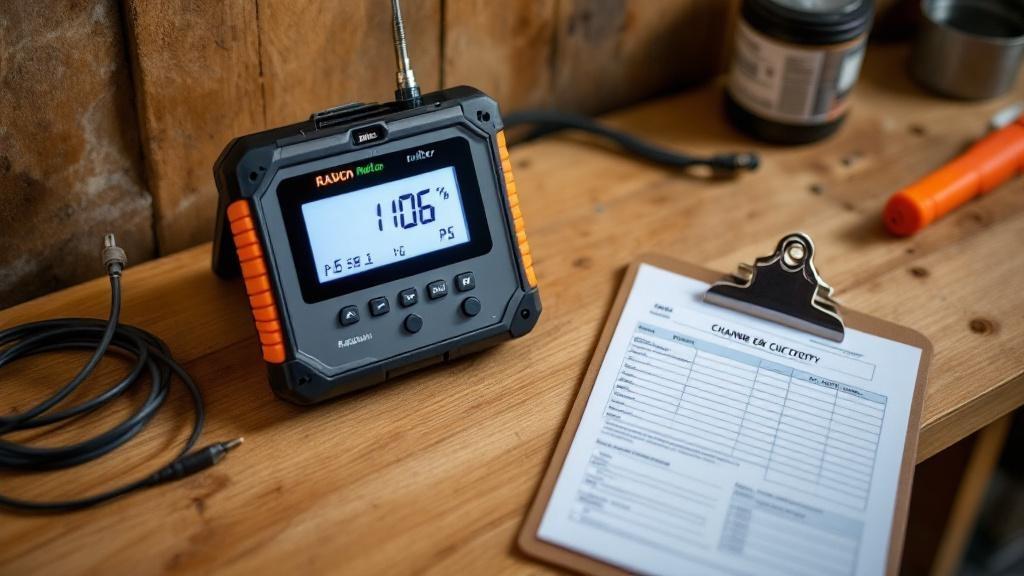
What this service covers
Measurement is its own licensed trade in Colorado: since July 2022, anyone testing for pay holds a DORA measurement license on top of NRPP or NRSB certification. Testing here covers real estate transactions, post-mitigation verification, and plain first answers, with devices placed to the ANSI/AARST measurement standard and results reported in writing with the conditions that produced them.
Typical pricing
$150-$275
Pricing varies by job specifics. Free phone or on-site quotes; fixed pricing once the technician has assessed the job.
Why a Fort Collins house gets tested before anything else
Every radon decision starts from one number, and northern Colorado's numbers argue for getting yours sooner rather than later. The City of Fort Collins reports that about half of homes in the city test at or above the EPA action level of 4 pCi/L. Larimer County's program has recorded results as high as 1,147 pCi/L, nearly three hundred times the action level, in a county whose average runs 7.8. CDPHE treats all 64 Colorado counties as high risk, and the EPA maps both Larimer and Weld as Zone 1.
None of those figures describes your house. Two homes on the same Severance street can read 2 and 20, because entry depends on the foundation, the soil pocket underneath, the sump, and how the house breathes. Averages justify testing; only the test justifies anything else.
A professional short-term test runs two to seven days under closed-house conditions and costs $150 to $275 here. A long-term device runs more than 90 days and captures the seasonal swing, which matters in a climate where winter stack effect can double what a July test sees. The honest default for a home you already own: short-term first, and a long-term follow-up if the result lands in the 2 to 8 band where one snapshot is a thin basis for a four-figure decision.
Placement, closed-house conditions, and what voids a result
A radon number is a measurement of conditions as much as of gas, which is why the ANSI/AARST measurement standard is picky about both. The device goes in the lowest level of the home that is lived in or could be, a basement rec room or lower tri-level den, not a crawl space, bathroom, kitchen, or closet. It sits away from exterior walls, drafts, sunlight, and heat sources, at breathing height, and far enough from the sump that it reads the room rather than the pit.
For short tests, closed-house conditions start 12 hours before the device does: windows closed, doors used only for coming and going, furnace running normally, no whole-house fan, no swamp cooler pulling outside air through the envelope. That last one is a genuinely northern Colorado detail, since evaporative coolers are common here and running one during a test floods the house with outside air and produces a uselessly low number.
Weather matters too. Chinook winds and spring storm fronts move indoor radon around, so a tester watches the forecast and notes conditions on the report. In a real estate transaction, tamper controls and a signed agreement about keeping conditions stable are what let the result stand when money is riding on it. If a number was taken with windows open in June, treat it as a rumor, not a reading.
Acting on a result, band by band
The EPA's framework is simple and worth taking at face value. At 4 pCi/L or higher, fix the home. Between 2 and 4, consider fixing, because no level is risk-free and the national indoor average is 1.3. Below 2, retest every couple of years and after any change to the foundation, the HVAC, or how you use the lowest level.
Northern Colorado adds a seasonal asterisk. A summer result in the 2 to 4 band deserves a winter follow-up before you relax, because a closed January house under inversion conditions pulls harder on the soil than an open June one. The reverse is also true: a 4.5 measured in deep winter is a real number, not a seasonal artifact to wave away, because winter is when you are actually breathing the air in question.
Whatever the result, keep the written report. It records where the device sat and under what conditions, which makes the next test comparable, and comparability is what turns a stack of numbers into a trend you can act on. For a result that came back high, the mitigation page covers what a fix involves, and the diagnosis guide sorts out which situation you are in.
Service area
Radon Testing is available across Fort Collins and northern Colorado. Per-suburb pages: