What this service covers
An active soil depressurization system puts the ground under your foundation at lower pressure than the house above it, so soil gas takes the pipe instead of the floor. Every install here is performed by a mitigation professional holding the Colorado license DORA has required since July 2022 (C.R.S. Title 12, Article 165) on top of NRPP or NRSB certification, is built to the ANSI/AARST SGM-SF-2023 standard, and ends with a verification retest so the number on paper is the number in your air.
Typical pricing
$1,400-$2,600
Pricing varies by job specifics. Free phone or on-site quotes; fixed pricing once the technician has assessed the job.
What a mitigation system actually does under a northern Colorado house
Radon is not a leak you patch. It is a pressure problem: a heated, closed-up house pulls gently on the soil beneath it, and the soil along the Front Range carries unusually radon-rich air to give up. Larimer County's health department puts the local average at 7.8 pCi/L against a national average of 1.3, which is the gap a system has to close.
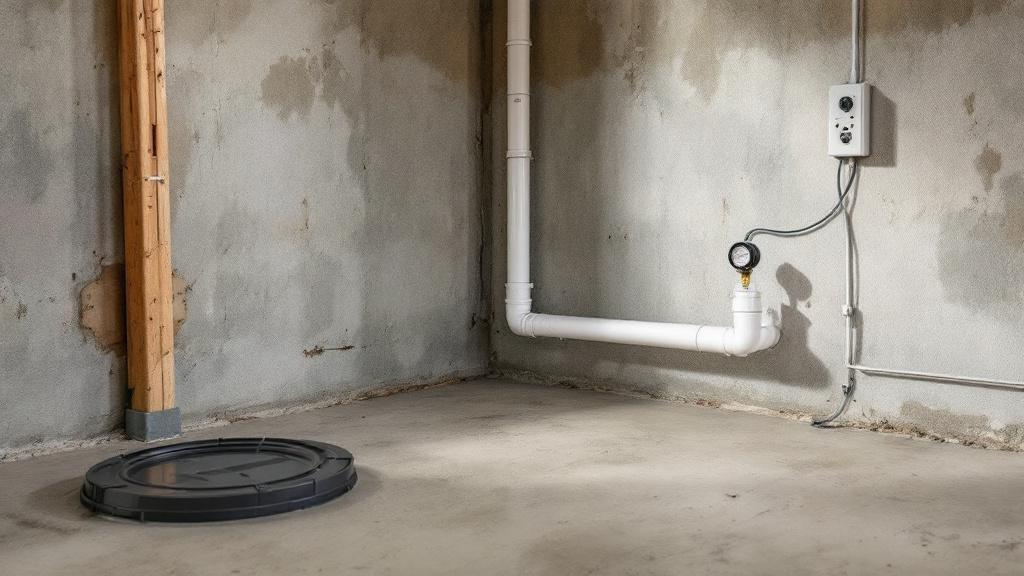
The fix reverses the pull. A suction point is cored through the slab (or set under a sealed membrane in a crawl space), schedule 40 pipe carries the soil gas up through the house or along an exterior wall, and an inline fan runs continuously so the soil side of the slab stays at lower pressure than your basement. Cracks, the floor-wall joint, and sump openings get sealed so the fan spends its effort on the soil rather than on your conditioned air. Done right, the gas exits above the roofline and dilutes to nothing.
What varies from house to house is not the idea but the airflow under the slab. A Windsor walkout with stepped footings, a Loveland tri-level with three foundation levels, and an Old Town Fort Collins cellar with a floor poured in patches each move air under the slab differently, and the suction-point count and fan sizing follow from that. The cost guide shows how those differences turn into price tiers.
Licensing and standards: what Colorado now requires
Colorado changed the rules in 2022, and the change is worth understanding before you sign anything. House Bill 21-1195 created C.R.S. Title 12, Article 165, and since July 1, 2022 anyone performing radon measurement or mitigation for pay in Colorado must hold a state license from the Office of Radon Professionals inside DORA, the Department of Regulatory Agencies. The license rides on top of national certification: a mitigation licensee holds a current NRPP or NRSB mitigation credential, keeps it in good standing, and renews with the state.
That gives homeowners a verification tool that did not exist a few years ago. DORA's license lookup shows whether a license is active, and it takes about a minute to check. All contractors you work with here are licensed with DORA and certified by NRPP or NRSB, and every install follows ANSI/AARST SGM-SF-2023, the national soil gas mitigation standard for homes. The standard governs the parts you can see, fan placement outside living space, a labeled system with a pressure gauge, a discharge point clear of windows and openings, and the parts you cannot, like how suction fields are diagnosed and how sealing is scoped.
The practical takeaway: in Colorado, an unlicensed quote is not a bargain, it is an unlawful one. Our FAQ on checking a Colorado radon license walks through the lookup.
Designing for the houses this market actually has
Northern Colorado's housing splits into a few radon archetypes, and the design follows the archetype more than the town. The 1970s-90s tri-levels and split-entries common across Midtown Fort Collins and Loveland stack two or three foundation levels under one roof, so a single suction point rarely reaches everything and the assessment has to treat each level as its own zone. Walkout basements, everywhere on sloped lots from Horsetooth to Water Valley, break the sub-slab air path at the daylight wall and often need the suction point placed against the uphill side.
New construction in Timnath, Windsor, and Severance mostly arrives with a builder's passive rough-in pipe. That stub is a head start, not a system: the City of Fort Collins reports roughly half of homes in town test at or above 4 pCi/L, and tight new envelopes concentrate whatever gets in. Activating a correctly run rough-in with a fan, gauge, and proper discharge is the least expensive full fix on our price list.
At the edges of the market the ground changes the job. Laporte and the acreage east of I-25 around Wellington bring crawl spaces, well water, and coarse decomposed-granite soils that move gas freely. Those houses get membrane systems and, where the air number and the well suggest it, a water test before anyone talks about water treatment. See crawl space mitigation for how membrane systems differ.
What you should hold in your hand when the job is done
A finished install should leave you with more than a pipe. Expect a written fixed-price quote before work starts, naming the scope, the suction-point count, the fan model, and the discharge route. Expect the license: the Colorado credential number of the mitigation professional on your job, checkable against DORA's lookup before you sign.
After the install, expect a labeled system. The pressure gauge (usually a U-tube manometer) gets marked at its startup reading so you can see at a glance, forever after, whether the fan is still pulling. The pipe is labeled as a radon system so a future inspector, buyer, or electrician knows what it is. And expect the verification retest: a post-install measurement, run to the ANSI/AARST measurement standard, that shows the system brought your number down rather than just added a hum to the attic.
Keep the bundle, quote, license number, startup reading, and retest result, with your house records. When you sell, that folder answers the radon question before a buyer's inspector asks it, and Colorado buyers ask. The selling with a system FAQ covers what that conversation looks like.
Service area
Radon Mitigation Systems is available across Fort Collins and northern Colorado. Per-suburb pages: